Who can precept a YSU nurse practitioner student
Youngstown State University's 2026-27 graduate handbook approves four kinds of preceptors for FNP and AGACNP practicums: nationally certified APRNs with a master's or doctorate, certified nurse-midwives, licensed physicians and, in limited cases, master's-prepared physician assistants. YSU's older online FAQ is stricter on physician assistants and adds experience minimums, so plan around both readings and let your clinical faculty settle any doubt before you submit.
Get your placement plan
Tell us your YSU program and where you live. A placement advisor replies with preceptor and site options in your community that fit your YSU course.
The approved list in the 2026-27 handbook
The current rulebook is the Graduate Nursing Student Handbook for 2026-27, revised in August 2026. Its preceptor section names the people YSU will approve, and your clinical faculty check each candidate against it before a single hour counts. The list is short:
- Nurse practitioners and other APRNs holding master's or doctoral preparation plus national certification that fits your specialty population.
- Certified nurse-midwives with a master's or doctorate, often useful for part of an FNP student's women's health hours.
- Physicians (MD or DO) with a license to practice medicine, working in primary care for FNP or in acute care for AGACNP.
- Physician assistants with a master's and a license in the practicum's state: allowed for AGACNP students, and for FNP students only within the limits in the next section.
The handbook sets no minimum years of practice for any of these groups. It does put a duty on the preceptor: each one completes the required preceptor documentation and agreements before your clinical experience begins.
Setting matters too. An FNP preceptor has to work in a primary care setting (adult, gerontology, pediatric or women's health), and an AGACNP preceptor in acute care, as the placement process guide sets out.
The physician assistant conflict
Here YSU's two sources disagree, and the gap decides who you can ask. The online FAQ, which carries no date and still names Medatrax and CastleBranch, accepts MD, NP or DO preceptors for both NP tracks and rules out physician assistants in plain words. The handbook revised in August 2026 opens that door partway.
| Question | Online FAQ (undated, older) | 2026-27 graduate handbook (revised 8/2026) |
|---|---|---|
| PA preceptor for AGACNP | Not allowed | Allowed if master's-prepared and licensed in the practicum state |
| PA preceptor for FNP | Not allowed | Up to 150 clinical hours, only after the first practicum is passed |
| First FNP practicum a PA can cover | None | NURS 7062 onward, once NURS 7061 is complete |
| Credentials named | MD, NP or DO; MSN as the minimum credential | APRN with national certification, CNM, MD or DO, and PAs as above |
When YSU documents clash, the newer handbook usually reflects current policy, but a 7-week practicum is too short to test that on the fly. Before you build a term around a physician assistant, ask your clinical faculty to confirm in writing that the handbook rule applies to you, and log PA-supervised hours separately so the 150-hour FNP ceiling is easy to check.
Years of experience: one, two or none stated
Experience is the second place YSU's documents part ways. The FAQ asks FNP preceptors for one year of experience and AGACNP preceptors for two, then states in a later line that one year is the requirement for both tracks and that only nurse practitioners, not physicians, need the full year. It also sets the MSN as the minimum credential.
The 2026-27 handbook names no year count at all. It asks instead for national certification suited to your population, which a newly certified NP can already hold.
The safe plan is to meet the strictest reading. An NP with two or more years in practice clears every version for AGACNP, and one year clears every version for FNP. If the preceptor you want is newer than that, raise it with your clinical faculty well before the two-month submission deadline, not after the paperwork is in.
The mistake that costs a term: lining up a physician assistant for NURS 7061. Even under the newer handbook, FNP hours with a PA begin only after the first practicum is complete.
Licenses: the preceptor's and yours
Every preceptor needs an active license where your hours happen. The handbook ties physician assistants to a license in the practicum state, and a nurse practitioner who precepts you in Pennsylvania, West Virginia or Michigan practices under that state's rules rather than Ohio's. Michigan, for example, grants NP specialty certification only to nurses holding a current Michigan RN license and national certification from a body its board recognizes.
Your own license matters as much: YSU requires an RN license that is current, unencumbered and valid in whichever state hosts your practicum hours, as the RN license rules guide explains. For practicums in Ohio, state nursing law lets an enrolled APRN student practice under the program's auspices while supervised by an APRN serving as faculty, teaching assistant or preceptor, and the Ohio Board of Nursing guide looks at how that exemption sits beside YSU's wider list of physician and PA preceptors.
The Student Preceptor Agreement and what gets signed
Each preceptor comes with paperwork. The online FAQ describes a three-page set of documents, the Student Preceptor Agreement together with the Clinical Site Request, which your preceptor signs along with someone authorized to sign for the site. The FAQ placed that packet in Medatrax; the 2026-27 handbook names Exxat as YSU's system for placement and documentation, so look for the current forms there or ask your clinical faculty.
The handbook adds a hard stop: clinical work cannot start until every compliance item is cleared and YSU holds an approved preceptor agreement for you. The archived 2022-23 handbook also had preceptors verify their licensure and certifications, still worth collecting up front.
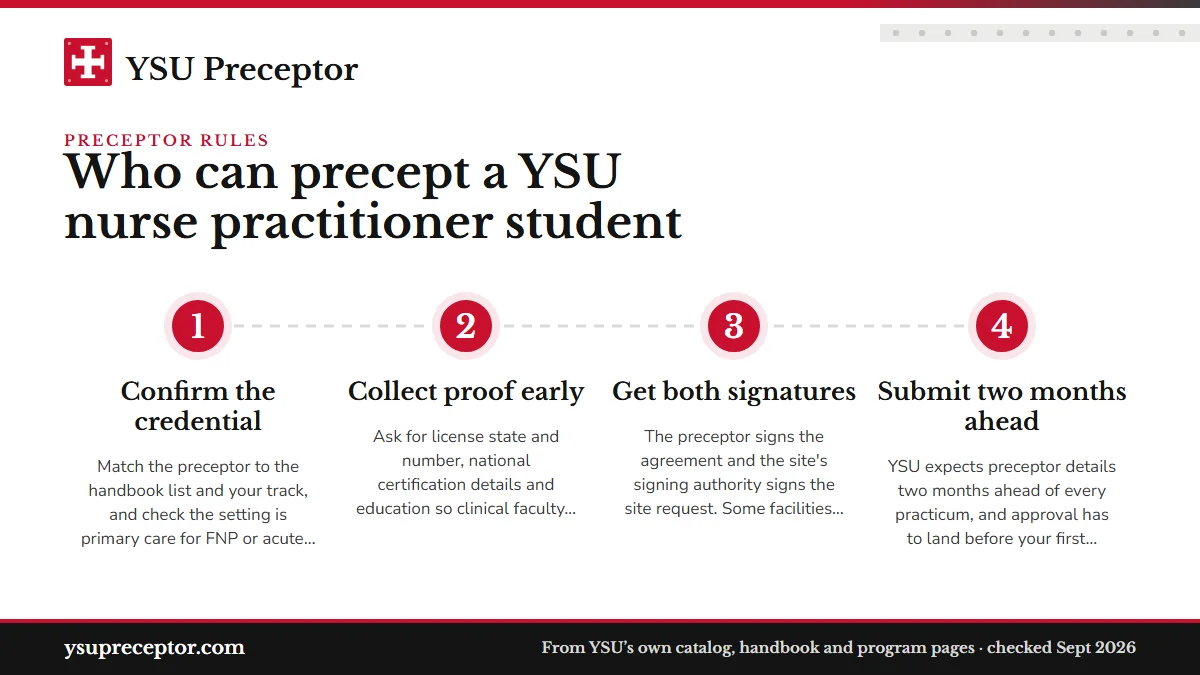
- Confirm the credentialMatch the preceptor to the handbook list and your track, and check the setting is primary care for FNP or acute care for AGACNP.
- Collect proof earlyAsk for license state and number, national certification details and education so clinical faculty can verify them without a second request.
- Get both signaturesThe preceptor signs the agreement and the site's signing authority signs the site request. Some facilities also need an affiliation agreement.
- Submit two months aheadYSU expects preceptor details two months ahead of every practicum, and approval has to land before your first hour. The approval timeline counts back from each start date.
Evaluations, hour verification and site visits
Once the practicum is running, the handbook gives your preceptor two continuing jobs: completing the student evaluations the program requires and verifying your clinical hours. Your clinical faculty, not the preceptor, award the final clinical grade, weighing the preceptor's evaluations alongside their own observation, your clinical documentation and practicum logs, and course assignments.
Faculty also check on you in person or by video, through the site visits or virtual evaluations the program calls for. The archived 2022-23 handbook set a minimum of one virtual site visit and used midterm and final evaluation forms; the current handbook does not publish the forms, which sit in Exxat with your course materials. Tell your preceptor early that a faculty check-in is coming.
YSU's FAQ also lets a practicum's hours be split among several approved preceptors, with no set number required. Each one needs approval first, so ask each to confirm the hours they supervised before your log closes.
How we match preceptors to YSU's rules
Your placement advisor screens every candidate against the handbook before your name goes anywhere: credential type, certification population, years in practice against the strictest FAQ reading, license state and the setting your practicum needs. We rule out anyone on your own unit or in your reporting line, and we hold physician assistants back for FNP students until NURS 7061 is behind you.
Then we gather what the Student Preceptor Agreement and site request ask for, so the packet reaches your clinical faculty complete, two months ahead and fitted to the exact practicum, NURS 7061 to NURS 7065 or NURS 7071 to NURS 7075. While one practicum runs, we line up the next preceptor. The approval decision stays with YSU's clinical faculty; our part is making sure the file in front of them is ready. Tell us your program and next start date.
Questions YSU students ask
Can a DNP-prepared nurse practitioner precept a YSU student?
Yes. The 2026-27 handbook accepts APRNs with a master's or a doctorate, provided they hold national certification suited to your specialty population. A DNP-prepared family NP in a primary care clinic fits the FNP practicums, and a DNP-prepared acute care NP on a hospital team fits the AGACNP practicums. Your clinical faculty still approve each preceptor individually.
Can a pediatrician supervise my YSU FNP pediatric hours?
Licensed physicians, MD or DO, are on the handbook's approved list, and pediatric primary care is one of the FNP settings YSU accepts. YSU recommends at least 100 pediatric hours within the FNP total, so a pediatrician or pediatric NP in a primary care office is a sensible way to cover them. The FNP hour mix guide shows how those hours fit.
Does my YSU preceptor have to practice in Ohio?
No. Your preceptor works in the state where your hours happen, which must be a state YSU accepts for your program, and both of you need licenses valid there. Ohio, Pennsylvania and West Virginia are accepted across the graduate programs, while the fourth state depends on which YSU page you read. See practicums outside Ohio.
Can I use more than one preceptor in a single YSU practicum?
Yes. YSU's FAQ says practicum hours may be split among several approved preceptors and sets no fixed number. Each preceptor needs approval before supervising you, so add a second name early rather than mid-term. A second approved preceptor at the same site is also a useful cushion if your main preceptor's schedule changes.
What if my preceptor is certified in a different population from my track?
The handbook asks for national certification that suits your specialty population, and clinical faculty decide what qualifies. A nurse practitioner certified for adults rather than families may suit some FNP adult hours, for instance, but ask before you submit. Send the preceptor's certification details to your clinical faculty so the question is settled before the two-month deadline.
Related pages
Last checked 2026-09-26
We check these pages against YSU's own catalog, graduate handbook, online program pages and FAQ, and Ohio rules. Your clinical faculty, the Graduate Clinical Coordinator and your advisor have the final word.
YSU asks you to secure your preceptor. We find one near you.
Tell us your YSU track, where you live and when your next practicum starts. We find preceptors near you who fit the practicum, check YSU's rules and hand you what the preceptor request needs, two months ahead, with the next term's preceptor already in view.
- Primary care preceptors for FNP practicums
NURS 7061toNURS 7065, acute care for AGACNPNURS 7071toNURS 7075 - Outside your own unit and away from your supervisor, in a state YSU accepts
- Across Ohio, from the Mahoning Valley to Cincinnati, and in Pennsylvania, West Virginia and Michigan
Start your placement plan
Program, city and start date is all we need to begin.