YSU's FNP hour mix: 200 adult, 100 pediatric, 75 women's health
Youngstown State University recommends that Family Nurse Practitioner students complete at least 200 hours in adult primary care, 100 in pediatric primary care and 75 in women's health primary care, with every hour in a primary care setting. Those minimums take up half of a 750-hour program and leave the rest to spend across adult, gerontology, pediatric or women's health practices. The catch is supply: several Ohio health systems' own student pages describe pediatric and women's health placements as the tightest.
Get your placement plan
Tell us your YSU program and where you live. A placement advisor replies with preceptor and site options in your community that fit your YSU course.
What YSU recommends, and where it says so
YSU's online FAQ says the FNP program includes a pediatric rotation and gives its clinical hour recommendations as three minimums: 200 hours in adult primary care, 100 in pediatric primary care and 75 in women's health primary care. A separate grid of acceptable sites requires a primary care setting for FNP hours and names four kinds: adult, gerontology, pediatric and women's health primary care.
The recommendation block still opens with a 600-hour total, the older figure explained in the FNP hours guide. The three minimums add up to 375 whichever total applies, and the table shows what is left over.
| Primary care setting (YSU's grid) | YSU's recommended minimum | Share of 750 (our arithmetic) |
|---|---|---|
| Adult primary care | At least 200 hours | About 27% |
| Pediatric primary care | At least 100 hours | About 13% |
| Women's health primary care | At least 75 hours | 10% |
| Gerontology primary care | No minimum stated | Part of the flexible hours |
| Flexible hours in any of the four | 375 of 750 (225 if the total is 600) | 50% |
Recommendation or requirement?
YSU calls the figures recommendations, yet frames each one as a minimum, and it states outright that the program includes a pediatric rotation. How clinical faculty check the mix, whether through course targets, Exxat encounter records or an end-of-program tally, is not published: practicum syllabi and Exxat forms are open only to enrolled students. The safe reading is to treat the minimums as the plan your clinical faculty expect to see.
Settings outside the four named kinds are worth settling before you count on them. YSU's grid puts urgent care and stand-alone emergency departments in the AGACNP column as acute care, and it names no specialty clinics for FNP students. The handbook has you document patient encounters in Exxat, so keep a running tally by setting from the first week rather than reconstructing it in the last practicum.
Spreading the mix over five practicums
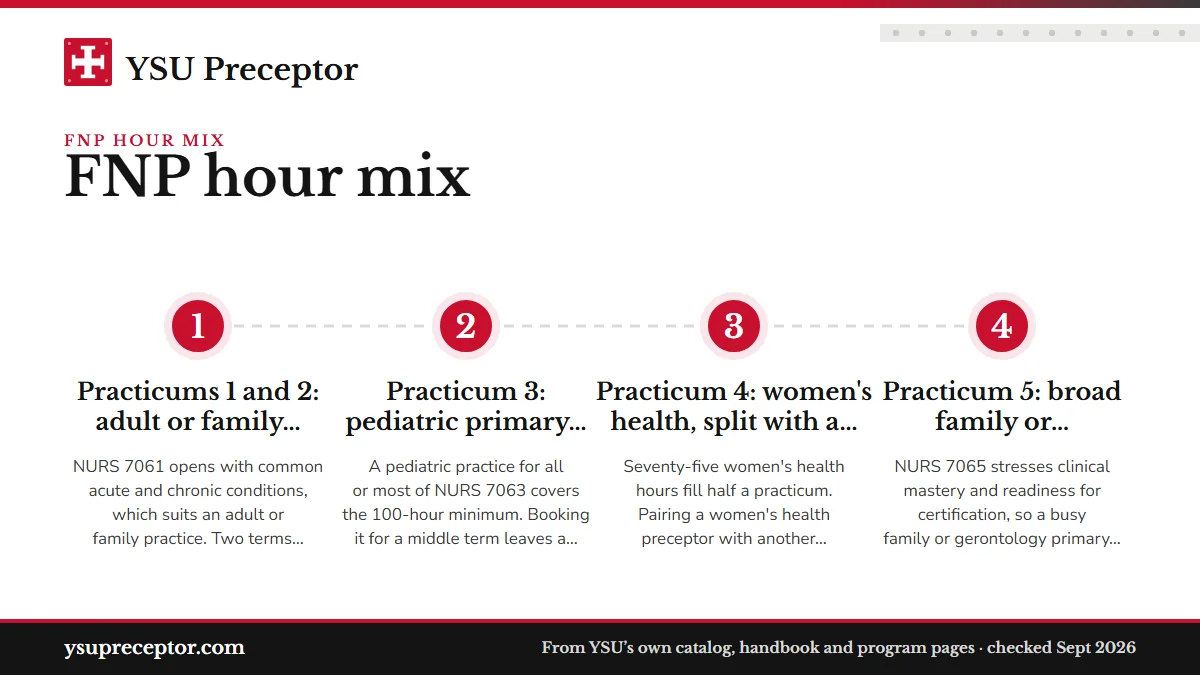
One way to cover the minimums, sketched by us rather than set by YSU, runs like this. Your curriculum plan and clinical faculty have the final word, and a different order works as long as the totals land.
- Practicums 1 and 2: adult or family primary care
NURS 7061opens with common acute and chronic conditions, which suits an adult or family practice. Two terms there give up to 300 hours and clear the 200-hour adult minimum with room to spare. - Practicum 3: pediatric primary careA pediatric practice for all or most of
NURS 7063covers the 100-hour minimum. Booking it for a middle term leaves a later term in reserve if the first choice falls through. - Practicum 4: women's health, split with a second preceptorSeventy-five women's health hours fill half a practicum. Pairing a women's health preceptor with another approved preceptor for the other half uses the FAQ's permission to divide hours, and the catalog frames
NURS 7064around patients across the lifespan. - Practicum 5: broad family or gerontology practice
NURS 7065stresses clinical mastery and readiness for certification, so a busy family or gerontology primary care practice rounds out the hours.
A family practice that sees children and women's health visits may seem to cover several categories at once, but YSU does not publish how a mixed day is logged. Ask your clinical faculty how to record it in Exxat before relying on it; a dedicated pediatric or women's health preceptor sidesteps the question.
Why pediatric and women's health preceptors are scarce
Ohio health systems' own student pages explain the squeeze. Premier Health in Dayton lists pediatrics, women's health and mental health as high-demand areas, and its placement page (archived March 2026) said it was not taking women's health requests at all. Memorial Health System in Marietta asks for pediatric and OB/GYN requests six months to a year ahead, and a 2025 copy of Kettering Health's student page listed no pediatric rotations.
The children's hospitals tell a similar story. Akron Children's, whose listing covers its Mahoning Valley campus, names Youngstown State University among its Family NP schools, while its Pediatric NP list names three other universities. Nationwide Children's calls FNP placements very limited, with one preceptor per term, and Cincinnati Children's says practicum requests exceed its placements; YSU is not on its affiliated-program list.
That points the search toward community practices: pediatric offices, family practices with large pediatric panels, OB/GYN offices and women's health clinics that provide primary care. The Mahoning Valley guide and the Akron and Canton guide cover the health systems and regions around YSU.
Book the scarce hours first
The sensible order runs against the practicum order: find the pediatric and women's health preceptors first, then fill adult primary care around them. Each added preceptor is another approval due two months ahead, and a site that needs an affiliation agreement can take longer than that; see affiliation agreements.
That is how we plan an FNP student's search. From admission we look for pediatric and women's health primary care preceptors near you, check each against YSU's grid and your workplace limits, and match them to the terms where they fit, then line up adult and family practice preceptors for the rest. You receive each preceptor's details ready for YSU's request, term by term.
Premier Health names pediatrics and women's health, not adult primary care, among its high-demand areas. Secure those 175 hours first and the rest of the mix falls into place.
Questions YSU students ask
Can I get YSU FNP hours at an urgent care?
Probably not without advance approval. YSU's settings grid lists urgent care in the AGACNP column as acute care and limits FNP hours to primary care: adult, gerontology, pediatric and women's health. Ask your clinical faculty before you commit a practicum to an urgent care, and have a primary care option ready.
Do gerontology hours count toward the 200 adult hours?
YSU does not say. Its grid lists gerontology primary care as a setting of its own, and the recommendation names minimums only for adult, pediatric and women's health. Treat gerontology time as separate unless your clinical faculty tell you otherwise, and plan the 200 adult hours without it.
Is the pediatric rotation optional for YSU FNP students?
Plan as though it is not. The FAQ states that the FNP program includes a pediatric rotation and recommends at least 100 pediatric primary care hours, and the catalog's description of NURS 7064 speaks of patients across the lifespan. Start the pediatric search early; the section on scarce preceptors above explains why.
What if I have no women's health preceptor by my last practicum?
Raise it early. YSU's FAQ asks students who cannot locate a preceptor to notify the Graduate Clinical Coordinator at least 90 days ahead, and 75 hours can fill part of a practicum alongside another approved preceptor. The can't find a preceptor page lays out the steps for this week.
Related pages
Last checked 2026-09-26
We check these pages against YSU's own catalog, graduate handbook, online program pages and FAQ, and Ohio rules. Your clinical faculty, the Graduate Clinical Coordinator and your advisor have the final word.
YSU asks you to secure your preceptor. We find one near you.
Tell us your YSU track, where you live and when your next practicum starts. We find preceptors near you who fit the practicum, check YSU's rules and hand you what the preceptor request needs, two months ahead, with the next term's preceptor already in view.
- Primary care preceptors for FNP practicums
NURS 7061toNURS 7065, acute care for AGACNPNURS 7071toNURS 7075 - Outside your own unit and away from your supervisor, in a state YSU accepts
- Across Ohio, from the Mahoning Valley to Cincinnati, and in Pennsylvania, West Virginia and Michigan
Start your placement plan
Program, city and start date is all we need to begin.