Ohio nurse practitioner practice, explained for YSU students
Ohio grants nurse practitioners an APRN license yet ties their practice to a written agreement, the standard care arrangement, with one or more physicians or podiatrists who collaborate with them. That tie is why AANP places Ohio in its reduced practice group. For a Youngstown State University student, these rules shape how an Ohio preceptor practices, what prescribing you will watch, and the license you apply for once you finish.
Find an Ohio preceptor who fits your practicum
Tell us your Ohio region and practicum dates. We match the preceptor's practice to your YSU course.
Ohio in brief: reduced practice
AANP's 2026 state practice map, dated May 2026, rates Ohio reduced practice. The deciding factor is the standard care arrangement: an Ohio nurse practitioner stays bound to a written plan shared with a physician or podiatrist for as long as they practice, not just for a transition period after licensure. Among the other states YSU accepts for online study, AANP also rates Pennsylvania and West Virginia reduced, and it rates Michigan restricted.
Reduced practice is a category, not a description of daily supervision. The Board does not require advance approval of a standard care arrangement, though it may review one, and certified nurse practitioners hold their own prescriptive authority under Ohio law. What the arrangement does require is a written plan the two clinicians agree on, set out below.
What a standard care arrangement involves
Board rule OAC 4723-8-01 describes the arrangement as a written, formal guide for planning and evaluating patient care, drawn up jointly by the APRN and the collaborating physician or podiatrist and meeting the terms of Revised Code section 4723.431. Under OAC 4723-8-04, a certified nurse practitioner practicing the specialty must have one in place with at least one collaborator whose own practice is the same as, or close to, the nurse's.
Four working rules follow from the Board's guidance and the statute.
- Matching fields: the collaborator's specialty mirrors the NP's, which in practice pairs an acute care NP with a physician in a comparable acute care field and a family NP with primary care.
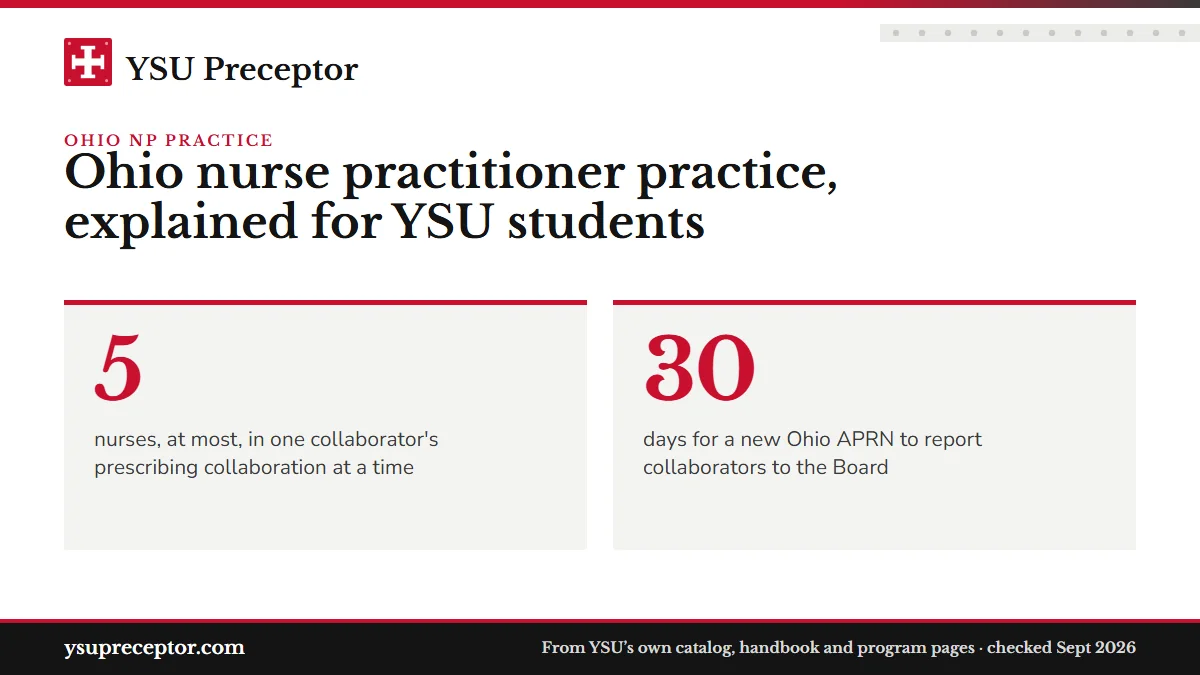
- Reporting: within 30 days of beginning practice, the APRN sends the Board each collaborator's name and business address.
- A ceiling: one physician or podiatrist may collaborate with no more than five nurses at once in the prescribing part of their practice.
- Review rather than preapproval: the Board does not sign off in advance but can examine the arrangement later.
Prescribing and its limits
Revised Code section 4723.481 authorizes certified nurse practitioners, clinical nurse specialists and certified nurse-midwives to prescribe. The boundaries come from an exclusionary formulary in Board rule OAC 4723-9-10, which names what APRNs may not prescribe instead of listing what they may. Prescribing APRNs must also register with OARRS, the state's prescription reporting system.
Schedule II drugs are where Ohio is tightest. Outside the settings the statute lists, an APRN may prescribe them only in narrow situations, such as a patient with a terminal condition or a drug a physician already prescribed, and for no more than 72 hours. For a student, that means the controlled-substance decisions you watch an Ohio NP make, and the ones they hand back to a physician, depend heavily on the setting.
The groundwork starts at YSU. The Board wants an advanced pharmacology course of at least 45 contact hours completed within five years before you apply for an APRN license, and YSU's handbook repeats the rule, so note when you finish NURS 6903 Advanced Pharmacology if your plan of study runs long.
The license: APRN, not certificate of authority
YSU's catalog and graduate handbook still tell graduates to apply for a Certificate of Authority to practice as an advanced practice nurse in Ohio. That wording predates a 2017 change in state law. Ohio now issues an APRN license, and the Board's own guide says each APRN designation needs a separate license, so read YSU's older phrase as the APRN license.
YSU's handbook also makes clear that finishing the MSN does not by itself confer licensure: national certification and a Board application come first. The Ohio Board of Nursing guide walks through the application and renewal, and the certification exams guide compares the boards YSU names for FNP and AGACNP graduates.
What Ohio's rules mean for your preceptor
An Ohio nurse practitioner who precepts you is practicing inside their own standard care arrangement, so the patients, settings and prescribing you see sit within that agreement's scope. It lines up neatly with YSU's setting rules: an FNP practicum needs a primary care NP whose collaboration is built around primary care, and an AGACNP practicum needs an acute care NP whose practice and collaborator are in acute care.
YSU's handbook also approves physicians as preceptors, and physician assistants in limited cases. Ohio's student statute, though, describes the student working under an APRN acting for the program, and the Board publishes no guidance we could find on physician or PA preceptors for NP students. If your Ohio preceptor is not an APRN, ask your clinical faculty how YSU handles it.
A preceptor in Pennsylvania, West Virginia or Michigan follows that state's rules instead; see clinicals outside Ohio. YSU's complete credential list is in the preceptor requirements guide.
Bills that could change the picture
Several bills in the 136th General Assembly, S.B. 258, H.B. 449 and H.B. 508, would let experienced CNPs, CNSs and CNMs practice without a standard care arrangement once they pass a threshold of clinical hours. As of September 2026 none had a committee report or a floor vote, so the arrangement remains Ohio law today. Bills can be amended at every stage, so check a bill's current text and status with the General Assembly before relying on any threshold you read about.
If one does pass before you graduate, the practice environment you enter could differ from the one your preceptors work in now. Until then, plan your career assuming you will need a collaborator in whatever specialty you choose, and keep an eye on the Board's announcements rather than advocacy summaries.
How we use Ohio's rules when we match you
For an Ohio practicum, your placement advisor looks for a nurse practitioner whose everyday practice matches the YSU course: primary care for NURS 7061 to NURS 7065, acute care for NURS 7071 to NURS 7075. We confirm license and national certification details for the Student Preceptor Agreement and note when a candidate is a physician or PA, so you can raise it with clinical faculty early rather than at approval.
Every preceptor is lined up well ahead of YSU's two-month deadline, with the next practicum already in view. When your practicum sits in Pennsylvania, West Virginia or Michigan instead, we apply that state's practice rules in the same way. Tell us your region and dates on the request form.
Questions YSU students ask
Can nurse practitioners in Ohio practice without a physician collaborator?
No. AANP's 2026 map puts Ohio in the reduced practice group because every Ohio nurse practitioner needs a standing arrangement with at least one collaborating physician or podiatrist, with no point at which the requirement ends. Pending bills would relax that after a set number of clinical hours, but none had moved out of committee by September 2026.
Can an Ohio nurse practitioner prescribe controlled substances?
Yes, within limits. Certified nurse practitioners have prescriptive authority under Ohio law and must register with OARRS. Schedule II drugs carry the tightest restrictions outside the specific settings the statute lists, and everything an APRN prescribes stays within the Board's exclusionary formulary, which sets out the drugs APRNs may not prescribe.
Does a new Ohio NP graduate need a collaborating physician before seeing patients?
Yes. Ohio requires a standard care arrangement for certified nurse practitioner practice from the first day, and the Board expects each collaborator's name and business address within 30 days of starting. Plan for the collaborator alongside your license application and job search, not after you have accepted a role.
Does Ohio's standard care arrangement cover nurse practitioner students?
No, it governs a licensed APRN's own practice. Students practice under a separate provision of the Revised Code that allows enrolled APRN students to work under their program's auspices while an APRN oversees them. Your preceptor's arrangement shapes the care you see, while the student provision covers you.
Related pages
Last checked 2026-09-26
We check these pages against YSU's own catalog, graduate handbook, online program pages and FAQ, and Ohio rules. Your clinical faculty, the Graduate Clinical Coordinator and your advisor have the final word.
YSU asks you to secure your preceptor. We find one near you.
Tell us your YSU track, where you live and when your next practicum starts. We find preceptors near you who fit the practicum, check YSU's rules and hand you what the preceptor request needs, two months ahead, with the next term's preceptor already in view.
- Primary care preceptors for FNP practicums
NURS 7061toNURS 7065, acute care for AGACNPNURS 7071toNURS 7075 - Outside your own unit and away from your supervisor, in a state YSU accepts
- Across Ohio, from the Mahoning Valley to Cincinnati, and in Pennsylvania, West Virginia and Michigan
Start your placement plan
Program, city and start date is all we need to begin.