NP certification exams after YSU's FNP and AGACNP programs
Youngstown State University prepares FNP graduates for the ANCC and AANP family nurse practitioner exams and AGACNP graduates for adult-gerontology acute care certification, where the handbook names AACN alongside ANCC and the catalog names ANCC alone. Here are the boards YSU names, the pass rates YSU reports for 2023 to 2025, how the final practicums build toward the exam, a caveat for certificate students, and the Ohio APRN license that follows certification.
Get your placement plan
Tell us your YSU program and where you live. A placement advisor replies with preceptor and site options in your community that fit your YSU course.
Which certification boards YSU names
YSU's catalog says FNP graduates are qualified and eligible for the American Nurses Credentialing Center exam and/or the American Academy of Nurse Practitioners FNP exam. The AANP exam is offered through the AANP Certification Board, known as AANPCB, and YSU's outcome page reports its FNP results under both names, AANP and ANCC.
The AGACNP picture depends on which YSU document you read. The catalog names only the American Nurses Credentialing Center, while the 2026-27 graduate handbook lists AACN and ANCC. The handbook is the newer document, but eligibility belongs to each board, so confirm it with the board itself before you register.
| YSU program | Exam or board YSU names | Where YSU says it |
|---|---|---|
| MSN Family Nurse Practitioner | ANCC and AANP (AANPCB) FNP exams | 2026-27 catalog; outcome data reports both |
| Post-master's FNP certificate | National certification; 600 supervised hours completed for eligibility | Catalog certificate page |
| MSN Adult-Gerontology Acute Care NP | ANCC | 2026-27 catalog |
| MSN Adult-Gerontology Acute Care NP | AACN and ANCC | Graduate handbook, revised 8/2026 |
| MSN or certificate, Nursing Education | Certified Nurse Educator exam (National League for Nursing) | Catalog program and certificate pages |
Eligibility and the hours question
Each board writes its own eligibility rules, and YSU's handbook says so directly: whether you can certify depends on meeting the certifying body's requirements. Read the current candidate handbook of the board you choose while you are still in your practicums, when there is time to fix a gap.
Hours are where YSU's documents need the closest reading. The online FNP and AGACNP program pages list five practicums of 150 hours each, 750 in total, while the 2026-27 catalog still gives 600 hours for FNP and 540 for AGACNP. The post-master's FNP catalog page ties its 600 supervised hours to national certification eligibility. Whatever the final figure, keep your Exxat hour logs and patient encounters complete; the FNP hours guide and the AGACNP hours guide set out the conflict.
FNP students also have a recommended spread to meet: a minimum of 200 hours in adult primary care, 100 in pediatric and 75 in women's health. The FNP role covers patients across the lifespan, and that mix places your practicum hours across adult, pediatric and women's health settings before you ever sit the exam.
Pass rates YSU reports
These figures are YSU's own, from its nursing program outcome data page. YSU reports 2026 results for AGACNP and the post-graduate certificates as pending.
| Year | FNP, AANP exam | FNP, ANCC exam | AGACNP | Post-graduate APRN certificate |
|---|---|---|---|---|
| 2023 | 83% | 91% | 85% | 100% |
| 2024 | 85% | 90% | 85% | 100% |
| 2025 | 92% | 90% | 85% | 100% |
Three cautions come with the table. The page does not say whether its years are calendar or academic years, it gives no count of test takers, and it reports AGACNP as a single figure without naming the board. Read the numbers as YSU's snapshot of its graduates, not as a forecast for any one student.
How NURS 7065 and NURS 7075 build toward the exam
YSU's catalog makes certification an explicit aim of the last FNP practicum. NURS 7065 puts the weight on mastering clinical care, working across professions, practicing with autonomy, and getting ready to certify and be licensed as a new FNP. It closes a sequence that opens with common acute and chronic conditions in NURS 7061, turns to differential diagnosis in NURS 7062 and to diagnostic reasoning and evidence in NURS 7063, and reaches patients across the lifespan, with leadership, in NURS 7064.
The AGACNP practicums widen independence in a similar arc. NURS 7071 starts with common acute problems under direct preceptor supervision, NURS 7073 moves into high-acuity settings such as intensive care and specialty units, and by NURS 7075 students take on acutely and critically ill patients more independently, with the preceptor supervising indirectly.
That arc rests on the preceptor. A final-practicum preceptor who lets you carry a fuller caseload and make the first call on a plan gives you the practice the catalog describes. We look for exactly that when we line up your last practicums: a primary care preceptor with the patient range the FNP mix calls for, or an acute care preceptor ready to move an AGACNP student to indirect supervision. Course-by-course detail lives in the NURS 7065 guide and the five AGACNP practicums guide, and you can send us your practicum dates to start the search early.
A caveat for post-master's certificate students
The handbook adds a warning for certificate students: eligibility depends on the certifying body, and post-master's students may be asked to retake any or all of the three P's, depending on the NP specialty they already hold. At YSU those are NURS 6902 Advanced Pathophysiology, NURS 6903 Advanced Pharmacology and NURS 6904 Advanced Health Assessment.
The certificate plans reflect the same idea. The 37-credit FNP certificate includes all three courses, and the AGACNP certificate table lists NURS 6903 and NURS 6904 unless completed previously. The advanced placement options, for applicants who already hold an MSN with nurse practitioner qualifications, drop to the specialty courses and the five practicums: 19 credits, although the AGACNP catalog text calls it an 18-hour option while its own table totals 19.
Before assuming an earlier graduate course carries over, ask your advisor and the board you plan to sit for. Ohio adds a timing rule for pharmacology, covered in the next section.
From certification to the Ohio APRN license
Certification alone does not let you practice as an NP in Ohio, and YSU's handbook adds that finishing the MSN does not automatically confer APRN licensure. The Ohio Board of Nursing issues an APRN license, a separate one for each designation, and YSU's FNP and AGACNP graduates apply as certified nurse practitioners.
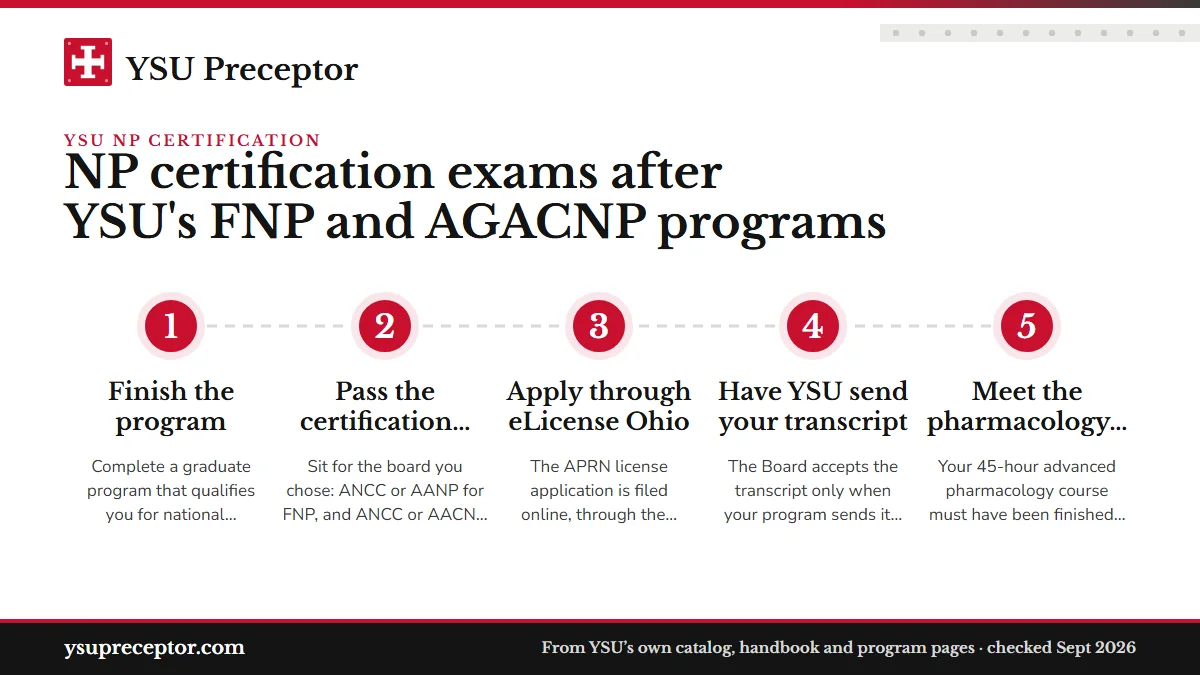
- Finish the programComplete a graduate program that qualifies you for national certification. YSU holds graduation at the close of fall, spring and summer.
- Pass the certification examSit for the board you chose: ANCC or AANP for FNP, and ANCC or AACN for AGACNP under the handbook.
- Apply through eLicense OhioThe APRN license application is filed online, through the state's licensing system.
- Have YSU send your transcriptThe Board accepts the transcript only when your program sends it; a copy you submit yourself is refused.
- Meet the pharmacology windowYour 45-hour advanced pharmacology course must have been finished in the five years before the application, an Ohio rule that YSU's handbook repeats.
- Keep your RN license baseAn Ohio APRN needs an active Ohio RN license or a multistate RN license issued by a Nurse Licensure Compact state.
YSU's catalog and handbook still call the credential a Certificate of Authority. Ohio replaced the certificate of authority with the APRN license in April 2017, and APRN license is the Board's term today. Licensed Ohio CNPs work under a written standard care arrangement agreed with a collaborating physician or podiatrist, explained in the Ohio NP practice guide. Renewal runs on a two-year cycle that falls in odd-numbered years and calls for 24 contact hours per APRN license, at least 12 of them in pharmacology.
Graduates living in Pennsylvania, West Virginia or Michigan turn to their own state's board after certification. No state-by-state licensure determination for the MSN appears in YSU's public disclosures; the state authorization guide covers what YSU does say.
Questions YSU students ask
Can I take both the ANCC and AANP FNP exams after YSU?
YSU's catalog says FNP graduates are eligible for the ANCC and/or AANP exams, and YSU reports results for both. Sitting for one or both is your decision. Each board sets its own eligibility, application steps and renewal rules, so compare their current candidate handbooks before choosing.
Does YSU's AGACNP program qualify me for the AACN exam?
The 2026-27 graduate handbook lists AACN and ANCC for AGACNP graduates, while the catalog names only ANCC. The handbook, revised in August 2026, is the fuller statement, but eligibility is the board's call: check AACN's current requirements against your transcript and logged hours before you register.
How soon after my final YSU practicum can I sit for boards?
YSU publishes no timeline, and each board sets its own rules on when graduates may test. What YSU fixes is the order: NURS 7005, the Capstone Practicum, has to come last, taken with NURS 7065 or in the following term, and YSU has three conferral points a year: December, May and August. Plan the exam around your conferral date and the board's requirements.
Can I practice in Ohio right after passing my boards?
Not yet. You also need the Ohio APRN license from the Board of Nursing, and an Ohio CNP needs a written standard care arrangement with one or more collaborating physicians or podiatrists. The Board also wants to hear, within 30 days of your first day in practice, who each collaborator is and the business address where they work.
Do YSU's Nursing Education graduates take a certification exam?
Yes, a different one. The catalog says MSN Nursing Education graduates are eligible for the national Certified Nurse Educator exam, and the post-master's certificate is built to ready students for the NLN's Certified Nurse Educator exam. It is an educator credential, not an APRN one, so no APRN license follows it.
Related pages
Last checked 2026-09-26
We check these pages against YSU's own catalog, graduate handbook, online program pages and FAQ, and Ohio rules. Your clinical faculty, the Graduate Clinical Coordinator and your advisor have the final word.
YSU asks you to secure your preceptor. We find one near you.
Tell us your YSU track, where you live and when your next practicum starts. We find preceptors near you who fit the practicum, check YSU's rules and hand you what the preceptor request needs, two months ahead, with the next term's preceptor already in view.
- Primary care preceptors for FNP practicums
NURS 7061toNURS 7065, acute care for AGACNPNURS 7071toNURS 7075 - Outside your own unit and away from your supervisor, in a state YSU accepts
- Across Ohio, from the Mahoning Valley to Cincinnati, and in Pennsylvania, West Virginia and Michigan
Start your placement plan
Program, city and start date is all we need to begin.