YSU BSN clinicals: how the school's clinical lab sections work
Youngstown State University arranges clinicals for its campus nursing students. In the entry-level BSN you register for a faculty-run clinical lab section alongside each lecture that has one, and the handbook expects you to be available for any day or shift from Monday to Saturday in Mahoning or Trumbull County. The ADN works the same way and adds Columbiana County.
Thinking about a YSU graduate track?
Tell us which program you are aiming for and when. A placement advisor will explain when the preceptor search should start.
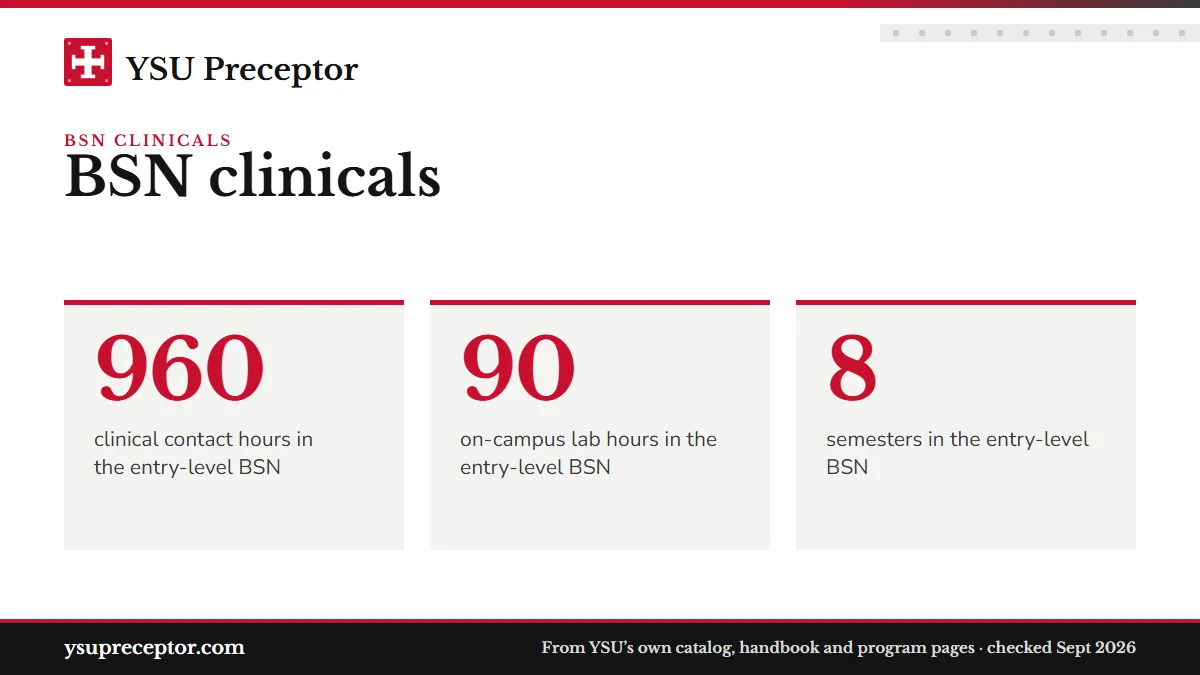
The entry-level BSN by the numbers
The undergraduate catalog describes a 121-semester-hour program (its course table shows a range of 120 to 125), of which 71 hours are nursing courses. On top of the credits sit 90 on-campus lab hours and 960 clinical contact hours in health care facilities and the community. The program runs eight semesters, and many of its nursing courses carry an off-campus clinical component.
Admission happens once a year, for fall registration. Licensed practical nurses can earn 11 semester hours of advanced standing after passing a clinical competency exam.
The BSN is accredited by ACEN, whose next visit is set for spring 2030, and YSU's baccalaureate program also holds CCNE accreditation through December 31, 2032. The catalog states that the Ohio Board of Nursing fully approves both the BSN and the ADN. The accreditation page explains what each approval covers.
You register; the school places
BSN clinicals are not something you arrange yourself. When a course has a clinical lab component, the BSN handbook requires you to register for both the lecture and its matching lab section, and the lab section is where the faculty-run clinical group lives. The school arranges the placement; you pick it up through registration.
Ohio's rules for prelicensure programs point the same way. Under Ohio Administrative Code 4723-5-20, the faculty member responsible for a course plans each student's clinical experience, assigns clinical experiences based on the course objectives and the student's learning needs, and evaluates the student's performance.
That is the reverse of YSU's online nurse practitioner tracks, where students are encouraged to line up their own preceptors and submit them for approval, as the placement process guide explains. Knowing both models now saves a surprise later.
Any day, any shift, Monday through Saturday
The BSN handbook sets a broad availability expectation: you must be able to attend any clinical day and location offered, Monday through Saturday, on day, evening or night shifts, in Mahoning or Trumbull County. The section that fits your registration may not be the time you would have chosen.
Planning around it
- Keep job hours flexible in semesters with clinical labs; a fixed weekday or weekend shift can collide with the section you land in.
- Plan reliable transportation across two counties, for early day starts and late evening finishes alike.
- Register as early as your window allows and keep backup sections in mind, since the lecture and its lab have to line up.
- Keep your compliance items current in Exxat, which YSU's nursing handbooks name as the school's compliance system.
The handbook asks for availability, not preference. Build your work and family schedule so that any Monday-to-Saturday day, evening or night section in Mahoning or Trumbull County is workable.
Where preceptors appear in the BSN
Most BSN clinical time is spent in faculty-led groups, but YSU also keeps a public information page for the registered nurses who precept students in NURS 4853. It gathers a letter to the preceptor, roles and expectations, the course syllabus, a clinical hours log and a preceptor evaluation, and it tells preceptors that the evaluation is the only form they return after each experience with a student.
Ohio defines a prelicensure preceptor narrowly: a registered nurse or licensed practical nurse who supervises a student's clinical experience at the agency where the preceptor works, oversees no more than two students at a time and carries out the clinical education plan at the direction of the course's faculty member. Faculty stay in charge of the experience even when an RN preceptor supervises it.
Graduate preceptors work under different rules entirely; the preceptor requirements page covers who may precept a YSU nurse practitioner student.
The ADN: two years and a third county
YSU's ADN, an Associate of Applied Science in Nursing, is a two-year program for new or transfer students entering without earlier nursing education or a diploma. It admits once a year, for spring registration, and runs 65 to 69 semester hours.
Clinicals follow the BSN pattern. The 2025-2026 ADN handbook uses the same rule of registering for the lecture and its lab section, and its clinical locations span Mahoning, Columbiana and Trumbull counties, so ADN students should expect a wider driving radius than BSN students. The Mahoning Valley guide covers the three counties.
On results, YSU reports an ADN NCLEX-RN pass rate of 100% (11 of 11) for its first graduating group in 2024 and 79.1% (76 of 96) in 2025. For the BSN, YSU reports rates between 81.55% and 88.24% from 2021 through 2025.
Preparing now for a graduate practicum later
If a YSU graduate program is in your plans, the clinical picture changes. The online FNP and AGACNP tracks run on precepted practicums with preceptors students are encouraged to secure for themselves, and YSU asks for the site and preceptor request to begin at admission. A few habits during and after the BSN make that easier:
- Keep your GPA at 3.0 or higher; the FNP catalog page asks for a 3.0 undergraduate GPA.
- Choose early jobs with the track in mind. The FNP needs a year of recent RN practice, the AGACNP a year of recent critical care such as emergency, ICU or intermediate acute care, and the anesthesia DNP a year of adult critical care (two preferred) plus a CCRN.
- Keep your RN license unencumbered and in the state where you expect to train, since the graduate programs require a license in the practicum state.
- Notice the nurse practitioners and physicians you work beside. The graduate FAQ lets NP students train at their employer, though not on their own unit or with their direct supervisor.
- Keep BLS and immunization records organized; graduate students must have compliance documents in Exxat at least 30 days before the first practicum.
The MSN FNP and DNP Nurse Anesthesia guides list the full admission requirements for each route.
When a placement advisor becomes useful
BSN and ADN clinicals are arranged by YSU, so there is nothing for a placement service to find while you are in them. Our work starts at the next step: the RN to BSN practicum for ADN graduates, or an online NP track or the Nursing Education practicum after the BSN. At that point a placement advisor can begin the preceptor search the week you are admitted, check each site against YSU's rules and keep the next practicum lined up while the current one runs. Bookmark the how it works page for when that day comes.
Questions YSU students ask
Can I pick my own clinical site in YSU's BSN program?
Not the way graduate students do. You choose a clinical lab section when you register, and the section carries the placement. The BSN handbook expects you to accept any available day and location from Monday to Saturday, on any shift, in Mahoning or Trumbull County, so plan for less choice than a lecture schedule gives you.
Do YSU BSN students have to find a preceptor?
No. Clinical groups are run by faculty, and for the precepted NURS 4853 experience YSU publishes the letter, syllabus, hours log and evaluation form for the RN preceptor. Ohio's prelicensure rules also put the planning and assignment of clinical experiences with faculty. Preceptor searches begin with YSU's RN to BSN and online graduate practicums.
Does YSU's BSN have night clinicals?
It can. The BSN handbook lists day, evening and night shifts among the times students must be able to attend, on any day from Monday through Saturday. Which shift a given course uses depends on the lab sections offered that semester, so check each semester's schedule before committing to work hours or childcare.
Can YSU BSN clinicals take place outside Ohio?
The BSN handbook's clinical locations are Mahoning and Trumbull counties, and the ADN adds Columbiana, all in Ohio. Under Ohio Administrative Code 4723-5-17, an Ohio prelicensure program that wants to use a facility in another state must first contact that state's board of nursing and document that it meets the board's requirements.
How do BSN clinicals differ from the RN to BSN practicum?
The entry-level BSN uses faculty-led clinical groups across many courses, adding up to 960 clinical contact hours. The online RN to BSN, for nurses who already hold a license, has 60 practicum hours, and the student identifies both the setting and a nurse leader to precept them, with a YSU contract behind each facility.
Related pages
Last checked 2026-09-26
We check these pages against YSU's own catalog, graduate handbook, online program pages and FAQ, and Ohio rules. Your clinical faculty, the Graduate Clinical Coordinator and your advisor have the final word.
YSU asks you to secure your preceptor. We find one near you.
Tell us your YSU track, where you live and when your next practicum starts. We find preceptors near you who fit the practicum, check YSU's rules and hand you what the preceptor request needs, two months ahead, with the next term's preceptor already in view.
- Primary care preceptors for FNP practicums
NURS 7061toNURS 7065, acute care for AGACNPNURS 7071toNURS 7075 - Outside your own unit and away from your supervisor, in a state YSU accepts
- Across Ohio, from the Mahoning Valley to Cincinnati, and in Pennsylvania, West Virginia and Michigan
Start your placement plan
Program, city and start date is all we need to begin.